

Repetition In Jfk Inaugural Address
 | |
| Date | January 20, 1961 (1961-01-20) |
|---|---|
| Location | United States Capitol, Washington, D.C. |
| Organized by | Joint Congressional Commission on Inaugural Ceremonies |
| Participants | John F. Kennedy 35th President of the Usa — Bold office Earl Warren Principal Justice of the U.s. — Administering adjuration Lyndon B. Johnson 37th Vice President of the U.s. — Bold office Sam Rayburn Speaker of the United States House of Representatives — Administering oath |
| | |
The inauguration of John F. Kennedy equally the 35th president of the United States was held on Fri, January xx, 1961, at the East Portico of the United States Capitol in Washington, D.C. It was the 44th inauguration, marking the commencement of Kennedy's presidency and Lyndon B. Johnson's just term equally vice president. Kennedy was assassinated 2 years, 306 days into this term, and Johnson succeeded to the presidency.
Kennedy had narrowly defeated Richard Nixon, the incumbent vice president, in the presidential election. He was the first Cosmic to go president, the youngest person elected to the office, and the first U.S. president to have been born in the 20th century.
His countdown address encompassed the major themes of his campaign and would define his presidency during a fourth dimension of economic prosperity, emerging social changes, and diplomatic challenges.[1] This inauguration was the offset in which a poet, Robert Frost, participated in the program.
For this inauguration, the Joint Congressional Committee on Inaugural Ceremonies was chaired past Senator John Sparkman, and included Senators Carl Hayden and Styles Bridges, and Representatives Sam Rayburn, John West. McCormack, and Charles A. Halleck.[2]
Sinatra inaugural brawl [edit]
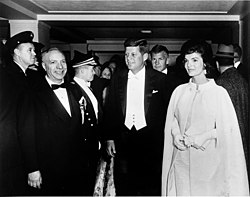
[Sinatra'south ball] may have marked the moment when pop entertainment became an indispensable role of modern politics.
— Todd S. Purdum, Vanity Off-white, Feb. 2011[3] [4]
Frank Sinatra and Peter Lawford organized and hosted a pre-inaugural brawl at the D.C. Armory on the eve of Inauguration twenty-four hour period, January nineteen, 1961, considered ane of the biggest parties ever held in the history of Washington, D.C.[3] [four] Sinatra recruited many Hollywood stars who performed and attended, and went every bit far as convincing Broadway theatres to suspend their shows for the night to accommodate some of their actors attending the gala.[four] With tickets ranging from $100 per person to $10,000 per group, Sinatra hoped to enhance $1.seven million ($fifteen.4 million in today's dollars) for the Democratic Party to eliminate its debt brought on by a difficult-fought campaign.[3] [4] Many Hollywood stars gave brief speeches or performed acts, apposite past Kay Thompson and directed by Roger Edens, and stayed at the Statler-Hilton Hotel where preparations and rehearsals were photographed by Phil Stern.[4] Performances and speeches included Fredric March, Sidney Poitier, Nat King Cole, Ella Fitzgerald, Gene Kelly, Tony Curtis, Janet Leigh, Beak Dana, Milton Berle, Jimmy Durante, Harry Belafonte, and Sinatra himself.
Sammy Davis, Jr., a long-time friend of Sinatra, supporter of the Democratic Party, and member of the Rat Pack, was asked by John F. Kennedy not to attend the gala at the behest of his father Joseph,[three] fearing that his interracial marriage to Swedish extra May Britt was too controversial for the time and occasion, much to Sammy's and Sinatra's dismay.[iii] [4] Davis had already postponed his wedding to Britt until after the ballot, likewise at the asking of the Kennedy campaign via Sinatra.[five] Davis eventually switched his support to the Republican Party and Richard Nixon in the early 1970s. Harry Belafonte expressed sadness at the controversy, stating "It was the ambassador, [but] nosotros didn't know that until later on. Sammy not being there was a loss."[3]
At the cease of the ball, Kennedy spoke to thank Sinatra on the festivities and his support of the Democratic Party throughout his life and the 1960 campaign, calculation "The happy relationship between the arts and politics which has characterized our long history I think reached culmination this night."[4] Jacqueline retired to the White House before the ball ended at 1:30 am (ET), and John went to a 2d pre-inaugural ball hosted by his father Joseph Kennedy, and would finally render to the White House at around iii:thirty am.[4]
The inaugural nor'easter [edit]
A major wintertime tempest occurred the twenty-four hours before the inauguration, with temperatures at 20 °F (−seven °C) and snowfall at i–2 inches (two.v–v.one cm) per 60 minutes[6] and a total of viii inches (20 cm) during the night,[7] causing transportation and logistical issues in Washington and serious concern for the inauguration.[half dozen] [7] [eight] [9]
On inauguration day, Jan twenty, 1961, the skies began to clear merely the snow created anarchy in Washington, almost canceling the inaugural parade.[6] The U.S. Regular army Corps of Engineers was put in charge of clearing the streets during the evening and morning earlier the inauguration, and were assisted by more than i,000 District of Columbia employees and one,700 Boy Scouts.[vi] This chore strength employed hundreds of dump trucks, front-end loaders, sanders, plows, rotaries, and flamethrowers to clear the road.[half-dozen] Over 1,400 cars which had been stranded due to the weather condition and lack of fuel had to be removed from the parade route forth Pennsylvania Artery.[six]
The snowstorm dropped visibility at Washington National Airport to less than half a mile,[six] preventing former president Herbert Hoover from flying into Washington and attending the inauguration.[x]
Inauguration proceedings [edit]

View of the extended East Forepart of the Capitol where the inauguration was held. President Kennedy is in the center delivering his inaugural address, with Vice President Johnson and official and invited guests sitting behind him.
Before proceeding to the Capitol in visitor with approachable president Dwight D. Eisenhower, Kennedy went to a morn Mass at Holy Trinity Catholic Church in Georgetown.[3] Cardinal Richard Cushing gave the invocation at the inaugural which lasted for 12 minutes.[eleven] Additional prayers were recited by Archbishop Iakovos of the Greek Orthodox Church and Reverend Dr. John Barclay of the Central Christian Church of Austin, Texas, and a blessing was offered past Rabbi Nelson Glueck. The invocation and prayers lasted a total of 28 minutes.[11] Marian Anderson sang "The Star-Spangled Banner", and a composition by Leonard Bernstein titled "Fanfare for the Inauguration of John F. Kennedy" was played.
The oath of office for vice president was administered by Speaker of the Firm of Representatives Sam Rayburn to Lyndon Johnson.[12] This marked the beginning time a House speaker administered the adjuration, which had been given in previous inaugurations by either the president pro tempore of the Senate, the outgoing vice president, or a United States senator.[thirteen]
Robert Frost, then 86 years old,[14] [fifteen] recited his verse form "The Gift Outright".[16] [17] Kennedy requested Frost to read a poem at the inauguration, suggesting "The Souvenir Outright",[17] [18] [19] considered an human action of gratitude towards Frost for his assist during the campaign.[19] Kennedy would afterwards country that he admired the "courage, the towering skill and daring" of Frost, and calculation that "I've never taken the view the world of politics and the world of poetry are so far apart. I think politicians and poets share at least one matter, and that is their greatness depends upon the courage with which they confront the challenges of life."[17] American poet William Meredith would say that the request "focused attention on Kennedy as a man of culture, as a man interested in culture."[nineteen]
For John F. Kennedy His Inauguration
The celebrity of a adjacent Augustan age
Of a power leading from its strength and pride,
Of young appetite eager to be tried,
Firm in our gratis beliefs without dismay,
In any game the nations desire to play.
A golden age of poetry and power
Of which this noonday's the kickoff 60 minutes.
—Closing seven lines from Robert Frost's poem
"For John F. Kennedy His Inauguration",
the expanded version of "Dedication".[20]
Frost composed a new poem titled Dedication specifically for the ceremony as a preface to the poem Kennedy suggested,[15] [19] to the surprise of Kennedy's friends.[21] On the forenoon of the inauguration, Frost asked Stewart Udall, Kennedy's hereafter Secretary of the Interior, to have his handwritten typhoon blazon scripted for easier reading, to which Udall obliged.[21]
Once at the presidential podium, however, the glare of the sun and snow prevented him from reading his papers.[17] [22] When Frost started reading, he stumbled on the showtime three lines, squinting at his papers in view of the crowd and cameras.[17] Vice President Johnson tried to assist by using his elevation lid as a shade, all the same Frost waved the offer aside, took the chapeau and jokingly said "I'll aid y'all with that", sparking laughter and applause from the oversupply and President Kennedy. Agreement the immediacy of the situation, Frost stated to the microphones that "this [the verse form] was to accept been a preface to a poem which I practise not have to read",[xviii] and began to recite "The Souvenir Outright" from retention[15] [17] [22] before the "nearly one meg people in the nation's capital".[23] This marks the first time a poem was read at a presidential inauguration, a characteristic repeated by future presidents Bill Clinton, Barack Obama, and Joe Biden at their respective ceremonies.[14] [24] [25] [26]
Frost gave the type scripted version of the undelivered "Dedication" poem to Udall subsequently the anniversary, who eventually donated the document to the Library of Congress where it is stored today.[21] The original manuscript version, personally dedicated by Frost, was provided to the president and currently held by the John F. Kennedy Presidential Library.[20] [27] Kennedy'southward wife Jacqueline framed this manuscript version, writing on the back of the frame: For Jack. Starting time thing I had framed to be put in your office. First matter to be hung there. [xx] [27] Frost officially presented the poem, retitled to For John F. Kennedy His Inauguration and expanded from 42 to 77 lines, to Kennedy in March 1962.[17] The unread poem (published in 1962 as part of Frost's In the Immigration poetry collection) was finally recited at the U.S. Capitol by Chaplain Daniel P. Coughlin during the 50th anniversary celebrations of Kennedy'southward inauguration.[15]
Adjuration of office [edit]
The oath of part of the president was administered to Kennedy by Chief Justice Earl Warren using a closed family Bible at 12:51 (ET) although he officially became president at the stroke of noon.[12] [28] [29] [thirty] [31] Kennedy did non wear an overcoat when taking the adjuration of function and delivering the countdown accost, despite the cold weather condition of 22 °F (−6 °C) with windchill at 7 °F (−fourteen °C) at noon.[six] [7] [32]
Countdown address [edit]
Video of John F. Kennedy being sworn in as thirty-fifth president of the United states of america, and delivering his countdown address.

Immediately subsequently reciting the oath of role, President Kennedy turned to address the crowd gathered at the Capitol. His 1366-word[33] inaugural address, the first delivered to a televised audition in colour,[14] is considered i of the best presidential inaugural speeches in American history.[34] [36]
Allow the give-and-take go forth from this fourth dimension and place, to friend and foe akin, that the torch has been passed to a new generation of Americans—born in this century, tempered by state of war, disciplined by a hard and bitter peace, proud of our ancient heritage—and unwilling to witness or permit the irksome undoing of those human rights to which this nation has e'er been committed, and to which we are committed today at home and around the world.[37]
And then, my fellow Americans: ask not what your state can practice for you lot—ask what you can do for your land.[37]
Drafting [edit]
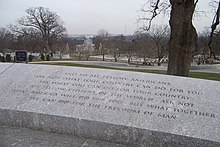
The spoken communication was crafted by Kennedy and his speech writer Ted Sorensen. Kennedy had Sorensen report President Abraham Lincoln's Gettysburg Accost also every bit other inaugural speeches.[38] [39] Kennedy began collecting thoughts and ideas for his inauguration speech in late November 1960. He took suggestions from various friends, aides and counselors, including suggestions from clergymen for biblical quotations. Kennedy then made several drafts using his own thoughts and some of those suggestions.[40] Kennedy included in his speech several suggestions made by Harvard economist John Kenneth Galbraith and by the one-time Democratic presidential candidate Adlai Stevenson II. Kennedy'south line "Allow united states of america never negotiate out of fear. But let us never fear to negotiate." is about identical to Galbraith'due south suggestion "We shall never negotiate out of fearfulness. Just we shall never fear to negotiate." Stevenson's proposition "if the free way of life doesn't help the many poor of this earth it will never save the few rich." was the ground for Kennedy's line "If a complimentary society cannot help the many who are poor, it cannot save the few who are rich."[41]
Main ideas of the speech [edit]
Kennedy came into power at the elevation of the Cold War with the hard goals of maintaining peaceful international relations and representing the United States as a strong global force. These themes dominated his inaugural accost. Kennedy highlighted the newly discovered dangers of nuclear power and the accelerating arms race, making the bespeak that a focus on firepower should be replaced with a focus on international relations and helping the impoverished of the globe.[42] According to speechwriter Ted Sorensen, the about important judgement in the oral communication, expressing the core of Kennedy'due south policy, was: "For merely when our arms are sufficient beyond doubt can we be certain beyond doubt that they volition never exist employed."[43] Sorensen revealed in 2007 that John F. Kennedy had five objectives in heed with his spoken language, all of which, according to Sorensen, were achieved.[44] Sorensen called Kennedy'due south speech "wise and courageous" and ended: "Kennedy'due south inaugural address was world-changing, heralding the commencement of a new American administration and foreign policy determined upon a peaceful victory in the west's long cold state of war struggle with the Soviet Matrimony over the globe'south time to come direction. [...] It was a statement of core values - his and the nation'due south at that time - that he very much believed needed to exist conveyed."[44]
Rhetorical elements [edit]
The main focus of the speech tin can crudely be boiled downwardly to one theme—the relationship between duty and power.[45] This is emphasized by Kennedy'southward strong use of juxtaposition in the beginning part of the speech. For example, he states in the second passage, "... Human being holds in his mortal hands the power to abolish all forms of human poverty and all forms of human life," a clear calling-out of non simply America, merely also other nations of ability for skewed Cold War priorities. He again employs the strategy in the fifth passage when he says, "United at that place is little nosotros cannot practice in a host of cooperative ventures. Divided at that place is little nosotros can do," again highly-seasoned to the thought of refocusing of international values.[46] Once again, later exhorting "both sides" to action, he calls on all of "us" "to deport the burden of a long twilight struggle ... against the common enemies of man: tyranny, poverty, disease, and war itself,"[47] though the phrase "long twilight struggle" came to be associated with the cold war struggle confronting communism.[48]
One of the primary components of classical rhetoric; kairos—which means to say or do whatsoever is plumbing equipment in a given situation, and is the way with which the orator wearing apparel the proof, as well as to prepon (the advisable)—which means what is said must conform to both audience and occasion, are as well extremely prevalent in this address.[49] Recognizing the fearfulness and anxiety prevalent in the American people since the start of the Common cold State of war, Kennedy geared his oral communication to have an optimistic and even idealistic tone every bit a means of providing comfort. He does this past quickly moving the fourth dimension of the speech communication into the futurity, and invokes repetition of the phrase "Let both sides ..." to allude to how he plans to deal with strained relations while also appealing to the end goal of international unity. He also phrases negative ideas in a mode so as to present them as opportunities—a challenge, appealing to innately American ideals. A great line to emphasize this is in the 4th from concluding passage, where he states, "In the long history of the world, only a few generations have been granted the role of defending liberty in its hour of maximum danger," a unproblematic twist of words that challenges the American public rather than frightening them.
It was also in his inaugural address that John F. Kennedy spoke his famous words, "enquire not what your country can do for you, inquire what you lot can exercise for your land." This use of antimetabole can be seen even as a thesis statement of his speech communication—a call to activeness for the public to practice what is right for the greater good. (This appears to be an elegant rephrasing of Franklin D. Roosevelt'southward acceptance speech at the 1936 Democratic National Convention: "To some generations much is given. Of other generations much is expected. This generation of Americans has a rendezvous with destiny.") [l]
Invited guests [edit]
Along with official presidential guests and honorees, including old presidents, vice presidents, chiffonier members, and other Washington officials, the Kennedys invited famous men and women of the arts, including Carl Sandburg, John Steinbeck, Ernest Hemingway, Brendan Behan, Marking Rothko, and fashion icon and hereafter Faddy editor Diana Vreeland.[3]
Congressman Tip O'Neill sabbatum adjacent to wealthy Boston businessman George Kara:[iii]
O'Neill recalled that Kara had nudged him and said, "Years from now, historians volition wonder what was on the immature man'due south mind as he strode to take his oath of part. I bet he's asking himself how George Kara got such a skillful seat." That night, O'Neill and his wife danced over to the president'due south box at the brawl in the Mayflower Hotel to congratulate him, and sure plenty, Kennedy asked, "Was that George Kara sitting beside you?" O'Neill told Kennedy what Kara had said, and J.F.Grand replied, "Tip, you'll never believe it. I had my left hand on the Bible and my right mitt in the air, and I was nigh to take the oath of role, and I said to myself, 'How the hell did Kara get that seat?'"
Presidents and commencement ladies [edit]
Five get-go ladies, Edith Wilson, Eleanor Roosevelt, Bess Truman, Mamie Eisenhower and Jackie Kennedy attended the event, every bit did time to come first ladies Lady Bird Johnson, Pat Nixon, and Betty Ford.
Old president Harry S Truman joined presidents Eisenhower and Kennedy on the platform, equally did future presidents Lyndon B. Johnson, Richard M. Nixon and Gerald Ford, making this, retroactively, the largest conclave of the "presidential fraternity" prior to the opening of the Reagan Library in the 1990s.
Parade to the White House [edit]
A vast parade along Pennsylvania Artery followed the inauguration anniversary, bearing the new president from Capitol Plaza to the White House. Upon his arrival, Kennedy mounted a reviewing stand shared with honored guests such equally quondam president Harry Truman and former beginning ladies Edith Wilson and Eleanor Roosevelt. Throngs of onlookers and millions of television viewers also watched the procession; it took 3 hours to pass by. Xvi thousand members of the US armed forces marched with displays of modern weaponry like the Minuteman missile and the supersonic B-70 bomber. A farther sixteen thousand marchers were civilians ranging from federal and land officials to high school bands and Boy Scouts, accompanied past forty floats.[51]
Bear upon [edit]
Kennedy'due south inauguration marked many firsts for the The states. Kennedy was the starting time Cosmic inaugurated as commander-in-chief.[52] At the inauguration, Kennedy, then 43, was the youngest elected president and was replacing the oldest president in American history at that fourth dimension, Eisenhower.[53] [54] [55] The historic period difference and visual impact of the turnover from Eisenhower'southward presence to Kennedy'southward was noticeable at the inauguration.[32] [56] In improver, Kennedy was the first person born in the 20th century to have been inaugurated as president.[57]
The claim that Kennedy did non wear a hat to his inauguration, and and then single-handedly killed the men'due south chapeau industry,[58] [59] [60] is imitation.[60] [61] Kennedy wore a pinnacle chapeau to the inauguration and to the assurance in the evening, removing it only to be sworn in and give his address. He in fact restored the tradition, afterward Eisenhower bankrupt with it by wearing a homburg instead of a pinnacle hat to both of his inaugurations.[sixty] Johnson, at his inauguration in 1965, was the first president to go completely hatless.[60] [61]
References [edit]
- ^ Bragdon, Henry W. (1998). History of a Free Nation. New York: Glencoe/McGraw-Hill. [ ISBN missing ] [ folio needed ]
- ^ "44TH Countdown CEREMONIES". The states Senate. Retrieved June fifteen, 2021.
- ^ a b c d e f g h i Purdum, Todd (February 2011). "From That Day Forth". Vanity Fair . Retrieved 2011-01-18 .
- ^ a b c d e f grand h Doyle, Jack (21 August 2011). "The Jack Pack, Pt. 2: 1961–2008". PopHistoryDig.com . Retrieved 16 Feb 2014.
- ^ Jacobs, George; Stadiem, William (2003). Mr. S.: The Last Give-and-take on Frank Sinatra. New York: HarperCollins. ISBN0-06-051516-3.
- ^ a b c d eastward f 1000 h Jason Samenow (January 9, 2009). "Inauguration Weather: The Case of Kennedy". The Washington Post . Retrieved February ten, 2010.
- ^ a b c "Presidential Inaugural Weather: Worst Traffic Jam - 1961". U.Due south. National Weather Service . Retrieved 11 Feb 2014.
- ^ Paul J. Kocin and Louis W. Uccellini (2004). Northeast Snowstorms. American Meteorological Society. p. 400. ISBNone-878220-64-0.
- ^ Andrea Stone (February 10, 2010). "Record Falls With Snow in Washington, DC". AOL News. Archived from the original on Feb 12, 2010. Retrieved February 10, 2010.
- ^ National Atmospheric condition Service Sterling, VA. "Presidential Inaugural Weather". National Oceanic and Atmospheric Administration. Retrieved Feb ten, 2010.
- ^ a b "Newdow five. Bush-league, 391 F. Supp. second 95 (D.D.C. 2005), Appendix D: Inaugural Clergy" (PDF). United states of america Commune Court, Commune of Columbia. 17 Dec 2004. p. ii of Appendix, footnote 26. No. Civ.A.04-2208(JDB). Retrieved 2014-02-xi .
- ^ a b "President John Fitzgerald Kennedy, 1961". Joint Congressional Commission on Inaugural Ceremonies. Retrieved 2009-01-21 .
- ^ "Inaugurals of Presidents of the U.s.: Some Precedents and Notable Events". Library of Congress, citing Roll Phone call article of 18 Jan 1961 . Retrieved fifteen February 2014.
- ^ a b c Wolly, Brian (17 December 2008). "History & Archaeology: Inaugural Firsts – When was the first inaugural parade? Who had the longest inaugural address? A look at presidential inaugurations through fourth dimension". Smithsonian Magazine . Retrieved 26 Jan 2013.
- ^ a b c d Wirzbicki, Alan (11 January 2011). "The poem Robert Frost wanted to read at John F. Kennedy's inauguration". Boston.com. Boston Globe. Archived from the original on Baronial 21, 2022. Retrieved 11 Feb 2014.
- ^ Tuten, Nancy Lewis; Zubizarreta, John (2001). The Robert Frost Encyclopedia. Greenwood Publishing Group, ISBN 978-0313294648
- ^ a b c d e f g Associated Press (thirty Jan 1963). "Robert Frost Dies at 88; Kennedy Leads in Tribute". New York Times. Archived from the original on September v, 2022. Retrieved 11 February 2014.
- ^ a b "Robert Frost Adds Poet's Touch on". The New York Times. 21 January 1961.
- ^ a b c d "Poetry and Power: Robert Frost's Inaugural Reading". Poets.org. Archived from the original on 12 Jan 2014. Retrieved eleven February 2014.
- ^ a b c Camia, Catalina (26 September 2010). "Why poet Frost made a final-minute switch at JFK's inauguration". USA Today . Retrieved xi February 2014.
- ^ a b c Birney, Alice. "Stewart 50. Udall Drove: Robert Frost's Dedication". Library of Congress . Retrieved xi February 2014.
- ^ a b "The Poetry of Robert Frost". Library of Congress. Retrieved May five, 2010.
- ^ "The Inauguration of John F. Kennedy: January xx, 1961". John F. Kennedy Presidential Library and Museum. January 20, 1961. Archived from the original on September 6, 2022. Retrieved September half dozen, 2022.
- ^ Michael E. Ruane (2008-12-17). "Pick Provides Civil Rights Symmetry". Washington Postal service . Retrieved 2009-01-xv .
- ^ Rosenthal, Harry (20 Jan 1997). "Poet Addresses Inaugural Event". Washington Postal service . Retrieved 11 Feb 2014.
- ^ Alter, Alexandra. "Amanda Gorman Captures the Moment, in Verse".
- ^ a b "Robert Frost'due south Original Verse form for JFK's Inauguration Finds Style to Kennedy Presidential Library". John F. Kennedy Library and Museum. JFKPOF-140-045. Retrieved January 8, 2008.
- ^ "John F. Kennedy and Republic of ireland – John F. Kennedy Presidential Library & Museum". Jfklibrary.org. Retrieved August xxx, 2010.
- ^ New York Times, January 21, 1961, p. 8, col. 1.
- ^ "White Firm Diaries". John F. Kennedy Library and Museum. Retrieved January viii, 2008.
- ^ "Kennedy Was in Function Despite Delay in Oath". The New York Times. Jan 21, 1961. p. xiii.
- ^ a b "Kennedy'due south Words, Obama's Challenge". The New York Times. January 19, 2009.
- ^ Peters, Gerhard (ed.). "Inaugural Addresses (including length in words) Washington – Trump". University of California, Santa Barbara: The American Presidency Project. Retrieved Oct 17, 2018.
- ^ Kennedy, John Fitzgerald. "Countdown Accost". American Rhetoric. Retrieved July 7, 2008.
- ^ "Greatest speeches of the 20th century". The Guardian . Retrieved 12 Feb 2014.
- ^ a b "John F. Kennedy Quotations: President Kennedy'southward Inaugural Accost, Jan 20, 1961". Boston Massachusetts: John F. Kennedy Presidential Library and Museum. Retrieved Oct 17, 2018.
- ^ JFK Library. "Analyzing the Countdown Address" (PDF). Archived from the original (PDF) on March 25, 2014. Retrieved January 21, 2011.
- ^ Theodore C. Sorensen (October 2008). "Ted Sorensen on Abraham Lincoln: A Man of His Words". Smithsonian Mag. Archived from the original on February 13, 2022. Retrieved February 13, 2022.
Abraham Lincoln, the greatest American president, was also in my view the all-time of all presidential speechwriters. As a youngster in Lincoln, Nebraska, I stood earlier the statue of the president gracing the west side of the towering state capitol and soaked up the words of his Gettysburg Address, inscribed on a granite slab behind the statue. 2 decades subsequently, in January 1961, President-elect John F. Kennedy asked me to report those words once again, in preparing to aid him write his inaugural accost. He also asked me to read all previous 20th-century inaugural addresses. I did not learn much from those speeches (except for FDR's first inaugural), but I learned a groovy bargain from Lincoln's ten sentences.
- ^ National Archives and Records Administration. "John F. Kennedy's inaugural accost, 1961". Retrieved January 29, 2008.
- ^ "Analyzing the Rhetoric of JFK's Inaugural Address" (PDF). Department of Educational activity and Public Programs, John F. Kennedy Presidential Library and Museum. John F. Kennedy Presidential Library and Museum. Retrieved viii January 2013.
- ^ "John F. Kennedy Inaugural Address". Bartleby.
- ^ Talbot, David (May 8, 2007). Brothers: The Hidden History of the Kennedy Years. London: Simon & Schuster U.k. Ltd. pp. 38–39. ISBN9781847395856.
Looking back, Ted Sorensen, Kennedy'southward essential collaborator, saw zilch contradictory about the countdown address. Information technology embodied, he said, Kennedy's central philosophy of peace through strength. "The line in the inaugural address that is the most of import is not 'Inquire not what your state can do for you.' It'due south 'For only when our arms are sufficient beyond doubt that tin can nosotros be certain beyond doubt that they will never be employed.' That was the Kennedy policy in a nutshell. He wasn't for unilaterial disarmament-on the reverse, he wanted to build an overwhelming nuclear advantage, so we'd never accept to use them, the Soviets would never dare to challenge us."
- ^ a b Ted Sorensen (April 22, 2007). "Keen speeches of the 20th century: The Kennedys. Ted Sorenson: JFK'due south countdown address was earth-changing". The Guardian. Archived from the original on August xv, 2021. Retrieved August 15, 2021.
- ^ "The Timeless Speech: A Close Textual Analysis of John F. Kennedy's Countdown". Biane.
- ^ "Text Analysis, John F. Kennedy, 1961." Cruz.
- ^ Thurston Clarke (2010). Ask Not: The Inauguration of John F. Kennedy and the Speech That Changed America. Penguin. p. 39. ISBN978-1101478059.
- ^ Thomas Alan Schwartz (1994). "Victories and Defeats in the Long Twilight Struggle: The United states and Western Europe in the 1960s". In Diane B. Kunz (ed.). The Affairs of the Crucial Decade: American Foreign Relations During the 1960s. Columbia University Press. p. 115. ISBN978-0231081771.
- ^ "Toward a Sophistic Definition of Rhetoric." Poulakos. Philosophy and Rhetoric 16(1983):35–48.
- ^ "Acceptance Speech for the Renomination for the Presidency, Philadelphia, Pa". presidency.ucsb.edu. Retrieved 2018-06-04 .
- ^ "Dazzling War machine Might Goes On Parade for New President". The Terre Haute Tribune. Terre Haute, IN. UPI. January 20, 1961. Retrieved December 10, 2016 – via Newspapers.com.

- ^ Frank Freidel and Hugh Sidey. "The Presidents of the United states of america of America: John F. Kennedy". WhiteHouse.gov. White House Historical Association. Archived from the original on 2 June 2011. Retrieved 31 May 2011.
- ^ "Reagan Now Oldest President". The New York Times. Reuters. May 17, 1981. p. 28.
- ^ Lawrence, Westward.H. (Jan 21, 1961). "Kennedy Sworn in, Asks 'Global Brotherhood' Confronting Tyranny, Desire, Disease, and State of war; Republicans and Diplomats Hail Address". The New York Times. p. i.
- ^ Business Insider. "Donald Trump is the oldest president elected in US history". Business Insider . Retrieved 12 May 2017.
- ^ Brooks, David (14 March 2011). "The Ike Stage". The New York Times . Retrieved 12 February 2014.
- ^ Hunker, Ian (20 January 2011). "Robert Frost and J.F.Grand., Fifty Years Afterward". The New Yorker . Retrieved 12 February 2014.
- ^ Robert Krulwich (4 May 2012). "Who Killed Men'southward Hats? Think Of A 3 Letter of the alphabet Word First With 'I'". NPR. Retrieved 16 August 2015.
- ^ Sam Parker (19 November 2013). "How to wear a hat and await skilful". Esquire . Retrieved xvi August 2015.
- ^ a b c d "Chapeau Play a trick on". Snopes. 27 September 2007. Retrieved 16 Baronial 2015.
- ^ a b "Countdown Traditions: Dude, Where'southward My Top Hat?". ABC News. 19 January 2009. Retrieved sixteen August 2015.
Bibliography [edit]
- Clarke, Thurston Ask Not : The Inauguration of John F. Kennedy and the Speech That Changed America. New York: Henry Holt and Co., 2004. ISBN 0-8050-7213-half-dozen.
- Rhetorical Terms and Techniques of Persuasion from Kennedy'southward Inaugural Accost. United states of america Department of Pedagogy and Public Programs, John F. Kennedy Presidential Library and Museum.
External links [edit]
- John F. Kennedy Presidential Library and Museum
- Library of Congress, John F. Kennedy Presidential Inauguration
- President Kennedy 1961 Inaugural Address (with audio) on YouTube
- Equally delivered text of Kennedy's Inaugural Address
- Audio of Kennedy'due south Countdown Address

Repetition In Jfk Inaugural Address,
Source: https://en.wikipedia.org/wiki/Inauguration_of_John_F._Kennedy
Posted by: potterlond1937.blogspot.com
0 Response to "Repetition In Jfk Inaugural Address"
Post a Comment