

How To Factorise X 2
One to one maths interventions built for KS4 success
Weekly online one to one GCSE maths revision lessons now available
Larn more
This topic is relevant for:

Factorising Quadratics
Here we will learn about factorising quadratics; we will explore what quadratic expressions are and the steps needed to factorise into double brackets.
There are as well factorising quadratics worksheets based on Edexcel, AQA and OCR exam questions, along with further guidance on where to go next if y'all're notwithstanding stuck.
First of all, let'due south have a quick recap on quadratic expressions.
What is a quadratic expression?
A quadratic expression in maths is an expression including a squared term or foursquare number i.e. a term up to
The highest power for a quadratic expression is
The general form of a quadratic expression is:
\[\colour{#FE47EC}ax^{2}\color{#00BC89}{+b}10\color{#7C4DFF}{+c}\]
e.g.
\[x^{2}\color{#00BC89}{-2}x\color{#7C4DFF}{+1}\]
\[\color{#FE47EC}2x^{2}\color{#00BC89}{+3}10\color{#7C4DFF}{-2}\]
We factorise quadratic expressions of this sort using double brackets. At that place are different methods we can apply depending on whether the coefficient of
What is factorising quadratics?
Factorising, or factoring quadratic equations is the opposite of expanding brackets and is used to solve quadratic equations.
For case, in the course of
How to factorise quadratics:
- Write out the factor pairs of the last number (c).
- Notice a pair of factors that+ to give the middle number (b) and multiply to give the terminal number (c).
- Write two brackets and put the variable at the offset of each ane.
- Write one factor in the first subclass and the other factor in the second bracket. The order isn't important, merely the signs of the factors are.
Quadratic expressions or quadratic equations?
A quadratic equation is a quadratic expression that is equal to something. We tin can solve quadratic equations by using factorisation (or factoring), the quadratic formula or by completing the square.
Pace by footstep guide: Quadratic equations

Factorising quadratics worksheets
Download 2 free factorising quadratics worksheets to help your students prepare for GCSEs. Includes reasoning and applied questions.
DOWNLOAD FREE
Factorising quadratics worksheets
Download ii free factorising quadratics worksheets to help your students prepare for GCSEs. Includes reasoning and practical questions.
DOWNLOAD Gratuitous
Factorising quadratics in the form xii + bx + c
To factorise a quadratic expression in the class
In this case, the coefficient (number in front) of the
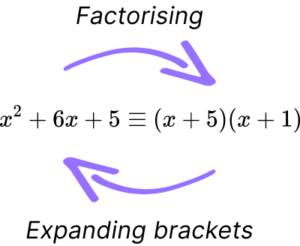
Explicate how to factorise a quadratic expression
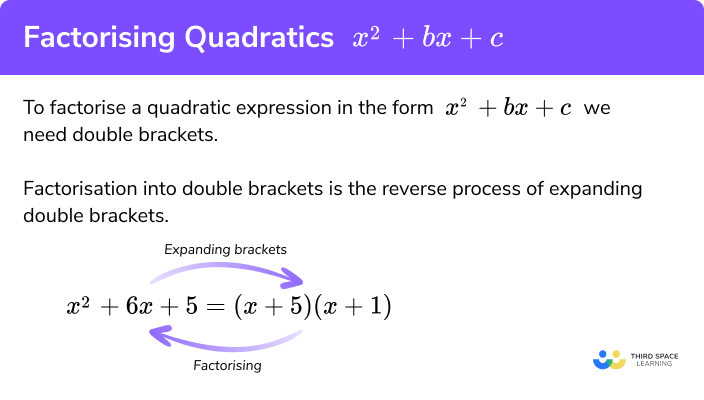
How to factorise quadratics: xtwo + bx + c (double brackets)
In order to factorise a quadratic algebraic expression in the class
- Write out the factor pairs of the last number
(c) . - Find a pair of factors that + to requite the center number
(b) and ✕ to requite the concluding number(c) . - Write two brackets and put the variable at the beginning of each one.
- Write ane gene in the outset bracket and the other gene in the second bracket. The order isn't important, the signs of the factors are.
Factorising quadratics examples: 102 + bx + c (double brackets)
Example 1: with +x coefficient and a + constant
Fully factorise:
\[10^2 \color{#00BC89}{+ 6x}\color{#7C4DFF} {+ 5}\]
- Write out the factor pairs of the last number (5) in lodge.
\[x^ii \colour{#00BC89}{+ 6x}\color{#7C4DFF} {+ five}\]
Factors of 5:
one, 5
2We need a pair of factors that + to give the center number (half dozen) and ✕ to give the last number (5).
\[x^2 \color{#00BC89}{+ 6x}\color{#7C4DFF} {+ 5}\]
Factors of 5:
one, v
(It's a good idea to do a quick check that we have the correct numbers)
Retrieve: to multiply two values together to requite a positive reply, the signs must be the aforementioned
iiiWrite two brackets and put the variable at the offset of each one (x in this instance).
\[(10\qquad)(x\qquad)\]
4Write one cistron in the kickoff bracket and the other factor in the second subclass. The order isn't of import, the signs of the factors are.
\[(x+\color{#FF9100}1)(10+\color{#FF9100}5)\]
Nosotros accept at present fully factorised the quadratic expression.
We can check the respond by multiplying out the brackets!
\[(ten+1)(10+five)=x^{ii}+6x+5\]
Instance 2: with -x coefficient and a – abiding
Fully factorise:
\[x^2 – 2x – 24\]
Write out the factor pairs of the final number (24) in club
Factors of 24:
1, 24
2, 12
three, 8
4, 6
We need a pair of factors that + to give the heart number (-two) and ✕ to give the last number (-24).
Factors of 24:
1, 24
2, 12
3, viii
four, half dozen
-6 + four = -2 ✔
-6 ✕ 4 = -24 ✔
(It's a good idea to practise a quick cheque that we have the correct numbers)
Call up: to multiply two values together to requite a negative answer, the signs must be the different.
Write ii brackets and put the variable at the outset of each one (ten in this case).
Write one factor in the kickoff bracket and the other factor in the second bracket. The society isn't important, the signs of the factors are.
We accept now fully factorised the quadratic expression.
We tin can check the answer by multiplying out the brackets!
Case three: with +x coefficient and a – constant
Fully factorise:
Write out the factor pairs of last number (twenty) in order.
\[10^{2}+10-twenty\]
Factors of 20:
ane, 20
2, 10
4, 5
We need a pair of factors that + to requite the centre number (1) and ✕ to give the last number (-20).
Factors of xx:
1, xx
two, 10
4, 5
-4 + 5 = 1 ✔
-4 ✕ 5 = -20 ✔
(It's a skillful idea to practice a quick cheque that we have the correct numbers)
Call up: to ✕ 2 values together to give a negative answer, the signs must be the different
Write 2 brackets and put the variable at the beginning of each one (x in this instance)
Write 1 factor in the first bracket and the other cistron in the second subclass. The gild isn't of import, the signs of the factors are.
We can check the answer by multiplying out the brackets!
Example four: with -x coefficient and a + constant
Fully factorise:
\[x^2 – 8x + xv\]
Write out the factor pairs of the last number (15) in social club.
Factors of fifteen:
1, 15
3, five
We need a pair of factors that + to give the eye number (-viii) and ✕ to give the last number (15).
Factors of fifteen:
ane, 15
iii, 5
-3 + -five = -8 ✔
-3 ✕ -5 = fifteen ✔
Information technology's a good thought to do a quick check that nosotros have the right numbers.
Recollect: to ✕ two values together to requite a positive answer, the signs must exist the same
Write ii brackets and put the variable at the start of each one (ten in this instance)
Write 1 gene in the first bracket and the other factor in the 2nd bracket.
\[(x – 3)(x – 5)\]
We have now fully factorised the quadratic expression.
We can cheque the answer by multiplying out the brackets!
Practice factorising quadratics questions: x2 + bx + c (double brackets)


We need numbers that have a product of 6 and a sum of v . By considering the factors of 6 , we conclude that x^{ii}+5x+6=(x+3)(x+2) .
We need numbers that accept a product of 21 and a sum of x . By considering the factors of 21 , we conclude that ten^{two}+10x+21=(x+3)(10+7) .
We need numbers that take a product of -12 and a sum of -1 . By considering the factors of -12 , we conclude that x^{2}-x-12=(ten-4)(x+three) .
We need numbers that take a product of -18 and a sum of 3 . Past because the factors of -18 , nosotros conclude that x^{ii}+3x-18=(10+6)(x-iii) .
We demand numbers that accept a product of viii and a sum of -half dozen . Past considering the negative factors of eight , we conclude that x^{ii}-6x+eight=(x-2)(x-4) .
Nosotros need numbers that have a product of 24 and a sum of -ten . By considering the negative factors of 24 , we conclude that 10^{2}-10x+24=(x-iv)(ten-half-dozen) .
Factorising quadratics GCSE questions: ten2 + bx + c (double brackets)
1. Factorise: x2 + 3x – ten
Prove answer
(2 marks)
2. Factorise: ytwo – 10y + 16
Testify answer
(2 marks)
3. Factorise: x2 – 12x + 27
Show respond
(ii marks)
Factorising quadratics in the form ax2 + bx + c
To factorise a quadratic expression in the course
In this case the coefficient (number in front) of the
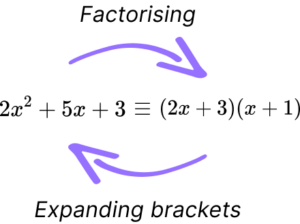
How to factorise quadratics: ax2 + bx + c (double brackets)
In order to factorise a quadratic algebraic expression in the form
- Multiply the end numbers together (
a andc ) so write out the factor pairs of this new number in order. - We need a pair of factors that + to give the middle number (
b ) and ✕ to give this new number. - Rewrite the original expression, this time splitting the eye term into the two factors we found in step 2. The order of these factors doesn't matter, the signs do.
- Split the equation down the middle and fully factorise each one-half. The expressions in the brackets must exist the same!
- Factorise the whole expression by bringing the contents of the bracket to the front and writing the two other terms in the other bracket.
Factorising quadratics examples: ax2 + bx + c (double brackets)
Instance one: with +x coefficient and a + abiding
Fully factorise:
\[2x^ii + 5x + 3\]
- Multiply the terminate numbers together (two and 3) then write out the gene pairs of this new number in guild.
Factors of half dozen:
1, six
ii, 3
2Nosotros demand a pair of factors that + to give the middle number (
Factors of vi:
1, 6
two, 3
+ five
✕ 6
2 + iii = v ✔
ii x 3 = half-dozen ✔
Remember: to x two values together to give a positive answer, the signs must exist the aforementioned.
3Get back to the original equation and rewrite it this time splitting the middle term into the two factors we institute in footstep 2 – the order of these factors doesn't matter, the signs do.
2x2 + 5x + iii
2xtwo + 2x + 3x + three
4Split up the equation down the eye into two halves and fully factorise each one-half – the expressions in the brackets must be the aforementioned!
2x2 + 5x + 3
2x2 + 2x + 3x + 3
2x(ten + 1) + 3(ten + 1)
5Now factorise the whole expression by bringing whatever is in the bracket to the front and writing the two other terms in the other bracket.
(10 + 1)(2x + 3)
The order of the brackets doesn't affair
We have now fully factorised the quadratic expression.
We can check the respond by multiplying out the brackets!
Case two: with +10 coefficient and a – constant
Fully factorise:
\[2x^ii + 3x – two\]
Multiply the the end numbers together (ii and -2) and then write out the factor pairs of this new number in order.
Factors of 4:
1, 4
two, ii
Nosotros demand a pair of factors that + to requite the centre number (iii) and ✕ to give this new number (-4)
Factors of four:
1, 4
2, two
⊕ 3
✕ -four
-1 + 4 = 3 ✔
-1 ✕ iv = -4 ✔
Remember: to x two values together to requite a negative answer, the signs must be different
Become back to the original equation and rewrite it this time splitting the eye term into the two factors we institute in step 2 – the gild of these factors doesn't matter, the signs do.
2xii + 3x - 2
2x2 - ten + 4x - 2
Carve up the equation down the centre into 2 halves and fully factorise each half – the expressions in the brackets must be the aforementioned!
2xii + 3x - 2 2x2 - x + 4x - 2 x(2x + 1) + 2(2x - 1)
Now factorise the whole expression by bringing whatever is in the subclass to the front and writing the ii other terms in the other bracket.
We have at present fully factorised the quadratic expression.
We tin can bank check the answer by multiplying out the brackets!
Instance three: with -x coefficient and a – constant
Fully factorise:
\[3x^2 – 2x – eight\]
Multiply the the end numbers together (iii and -8) then write out the factor pairs of this new number in order.
Factors of 24:
1, 24
2, 12
3, eight
4, 6
We need a pair of factors that + to give the middle number (-2) and to ✕ give this new number (-24)
Factors of 24:
1, 24
2, 12
3, 8
4, vi
⊕ -2
✕ -24
-6 + 4 = -2 ✔
-6 ✕ four = -24 ✔
Remember: to ✕ two values together to give a negative answer, the signs must be unlike
Go dorsum to the original equation and rewrite it this time splitting the centre term into the 2 factors nosotros institute in step two – the order of these factors doesn't affair, the signs do.
3xii - 2x - eight
3x2 - 6x + 4x - 8
Split the equation downward the middle into two halves and fully factorise each half – the expressions in the brackets must be the same!
3x2 - 2x - viii
3x2 - 6x + 4x - eight
3x(x - two) + 4(x - ii)
Now factorise the whole expression by bringing whatsoever is in the bracket to the front and writing the ii other terms in the other subclass.
We accept now fully factorised the quadratic expression.
We can check the answer by multiplying out the brackets!
Case 4: with -x coefficient and a + abiding
Fully factorise:
\[ 6x^2 – 7x + 2 \]
Multiply the the end numbers together (6 and ii) then write out the factor pairs of this new number in society.
Factors of 12:
1, 12
2, half dozen
3, 4
We demand a pair of factors that + to give the heart number (-7) and ✕ to give this new number (12)
Factors of 12:
1, 12
2, 6
3, four
+ -seven
✕ -24
-3 + -4 = -7 ✔
-3 ✕ -4 = 12 ✔
Remember: to ✕ two values together to give a positive answer, the signs must be the same
Go dorsum to the original equation and rewrite information technology this fourth dimension splitting the middle term into the two factors we found in step two – the order of these factors doesn't matter, the signs practise.
6xii - 7x + 2
6x2 - 3x - 4x + 2
Split the equation down the middle into two halves and fully factorise each one-half – the expressions in the brackets must be the aforementioned!
6x2 - 7x + 2
6xtwo - 3x - 4x + two
3x(2x - 1) - 2(2x - one)
Now factorise the whole expression by bringing whatsoever is in the subclass to the front and writing the two other terms in the other bracket.
We take now fully factorised the quadratic expression.
We tin check the answer past multiplying out the brackets!
Practice factorising quadratics questions: ax2 + bx + c (double brackets)
Using the method from the above lesson, we can rewrite 2x^{ii}+5x+two as 2x^{2}+4x+x+2 which can be factorised as 2x(x+2)+1(x+ii) or more than concisely, (2x+1)(ten+ii) .
Using the method from the in a higher place lesson, we can rewrite 2x^{2}+x-6 as 2x^{two}-3x+4x-6 which can be factorised as 10(2x-iii)+ii(2x-3) or more concisely, (2x-three)(10+ii) .
For the given expression, 2x^{2}-14x+20 commencement factor out the HCF of 2 , giving 2[x^{two}-7x+10] then use the method from the lesson to factorise this simpler expression, hence ii[x^{2}-5x-2x+x] or 2[10(ten-v)-2(x-5)] so that the fully factorised expression is 2(x-2)(x-5) .
Using the method from the above lesson, nosotros can rewrite 3x^{2}-7x-6 as 3x^{two}-9x+2x-six which tin be factorised equally 3x(x-three)+2(x-iii) or more concisely, (3x+2)(x-3) .
Using the method from the above lesson, we tin rewrite 3x^{2}-7x+two as 3x^{2}-6x-x+two which tin can be factorised equally 3x(x-ii)-(x-2) or more concisely, (3x-1)(x-2) .
For the given expression, 4x^{ii}-18x+viii first gene out the HCF of 2 , giving ii(2x^{two}-9x+4) then use the method from the lesson to factorise this simpler expression, hence two[2x^{2}-8x-10+4] or two[2x(x-iv)-(ten-iv)] and then that the fully factorised expression is 2(2x-1)(x-four) .
Factorising quadratics GCSE questions: ax2 + bx + c (double brackets)
1. Factorise: 2xii + 9x + four
Testify reply
(two marks)
ii. Factorise: 2ytwo – y – 3
Testify answer
(2 marks)
3. Factorise: 2xtwo – x – 10
Show reply
(2 marks)
Common misconceptions
- The club of the brackets
When we multiply ii values the social club doesn't thing. This is true for the brackets when factorising quadratics
east.g.
two ✕ 3 = 3 ✕ 2 Information technology is exactly the same here.
(x – 6)(x + 4) means(ten – 6)(x + 4) And so,
(x – 6)(ten + iv)=(x + iv)(10 – half dozen)
- The signs of the factors
Information technology is common for students to get confused regarding the signs of the factors in the brackets, especially with negative factors.e.one thousand. if the factors are
-6 andiv , the numbers is the brackets must exist:
(10 – 6)(x + four)
- Multiplying two numbers to give a +
For two numbers to multiply to give a + their signs must be the same, that is a negative 10 a negative or a positive ten a positive.
+ ✕ + = +
e.yard 2 ✕ three = vi
four ✕ 5=xx
– ✕ – = +
east.thousand -ii ✕ -iii = half dozen
-four ✕ -5= 20
- Multiplying two numbers to give a –
For ii numbers to multiply to give a – their signs must exist unlike, that is a negative x a positive or a positive x a negative.
+ ✕ – = –
east.g 2 ✕ -iii= -half-dozen
iv ✕ -5= -twenty
– ✕ + = –
e.g -2 ✕ 3= -six
-iv ✕ 5= -20
- The signs are important for the end numbers equally well
due east.g. 3x^{2} - 2x - eight
3 x -8 = -24 Non 24
- Run into besides: Negative numbers
Learning checklist
Y'all have at present learnt how to:
-
Manipulate algebraic expressions by taking out common factors to factorise into a single subclass - Factorise quadratic expressions of the grade x^{2} + bx + c
-
Factorise quadratic expressions of the form of the difference of two squares - Factorising quadratic expressions of the course ax^{two} + bx + c (H)
However stuck?
Ready your KS4 students for maths GCSEs success with 3rd Space Learning. Weekly online one to one GCSE maths revision lessons delivered past practiced maths tutors.

Observe out more well-nigh our GCSE maths revision programme.
Nosotros employ essential and non-essential cookies to improve the experience on our website. Delight read our Cookies Policy for information on how we use cookies and how to manage or modify your cookie settings.Accept

How To Factorise X 2,
Source: https://thirdspacelearning.com/gcse-maths/algebra/factorising-quadratics/
Posted by: potterlond1937.blogspot.com
0 Response to "How To Factorise X 2"
Post a Comment