

Alexander The Great Travel Map
Alexander III of Macedon, more unremarkably known as Alexander the Neat, was male monarch of the Ancient Greek kingdom of Macedon, which today is divided amid three countries. He inherited the kingdom at the age of twenty in 336 BC, and by the age of xxx he had forged 1 of the largest empires in the ancient world, uniting the Greek-metropolis states and neighboring foes, taking Egypt, conquering the Achaemenid (First Persian) Empire and successfully invading the Indian subcontinent. He died at 32 so he did not rule his empire for long, but after his death dynasties descended from his generals ruled parts of it for centuries.
Never defeated in battle, Alexander is considered to be one of the most successful and influential military machine leaders of all fourth dimension. Even today in virtually armies, officer trainees report his tactics.
Empathize [edit]
- Come across also: Ancient Greece, Persian Empire, Roman Empire
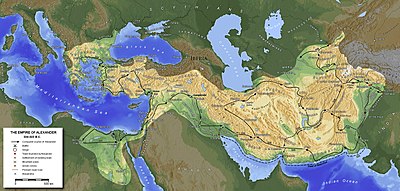
Alexander's conquests covered a wide area. A first approximation to following his route today would be the Hippie Trail of the 1970s, overland from Istanbul to Delhi. Even so that route generally omits Greece and various areas he conquered — the Levant, Egypt, Iraq and the northern parts of the Persian Empire in Cardinal Asia.
Merchandise along the Silk Route became well established not long after Alexander, and much of that route was in territory he had conquered.
Alexander founded many cities. Wikipedia says he either founded or renamed about 70 and gives a list of nigh xxx of the more of import ones, and we mention some below. Most were in strategic locations, and many of the initial inhabitants were veterans.
Destinations [edit]
We list some of the main sites along Alexander's route below, in the gild he visited them and so mainly west to east. Sites which are of import simply as battlegrounds take ruby markers. Other places go dark-green markers, though at that place were also battles for many of those.
Greece [edit]

Map of On the trail of Alexander the Great
Philip Ii of Macedon was Alexander'southward father. His alliances and conquests, and Alexander's early ones, gave the Macedonians command of all of Greece and some nearby areas:
In 336 BC Philip was assassinated by his bodyguard and Alexander was proclaimed rex. Philip had forged and led an alliance, the Hellenic League, which united most of Greece to attack the Persians, who had invaded Hellenic republic during the previous century and nevertheless controlled many areas in Anatolia (now Asiatic Turkey) where the population was predominately Greek. After Philip's death, Alexander was appointed its leader.
Mediterranean [edit]
With the Greek base secured, and many Greek allies, Alexander moved confronting Mediterranean areas held by Persia:

- 3 Issus (Syrian Gate). This was the first of Alexander's battles in which the opposing Farsi forces were led past their Emperor, Darius III, in person. The Greeks won, despite being seriously outnumbered. The battle took place in 333 BC.

- five Iskenderun (Alexandretta). Founded equally Alexandria ad Issum, to control the "Syrian Gate" laissez passer over which the Battle of Issus was fought. Today Iskenderun is the biggest city in Turkey's Hatay province, on the shore of the Mediterranean, with a pleasant palm-lined waterfront.

- 6 Tyre (Due south Lebanon). This Phoenecian urban center, already ancient in Alexander's 24-hour interval, was the site of Alexander's almost famous siege. Later it was an important city under the Romans. Today it is Lebanon'due south fourth largest city, known for well-preserved Roman architecture, including the largest and all-time-preserved example of a Roman Hippodrome, and for fine beaches.
- 7 Gaza. Alexander besieged this urban center. After three unsuccessful attempts, he breached the walls on the fourth attempt and his infantry overwhelmed the defenders. Once the city fell, about men of fighting age were slaughtered while the women and children were sold into slavery.
Taking Gaza opened upwards the pathway for the Macedonians and their allies to march into Arab republic of egypt, and once Gaza fell the Farsi satrap of Egypt surrendered without a fight.
Persia [edit]
After taking Anatolia and Persia's Mediterranean territories, and rejecting a series of peace offers from Darius, he continued e to conquer the rest of the Persian Empire:

Cardinal Asia [edit]
After the fall of Persepolis, the Persian Emperor Darius fled to the northern parts of his empire, in Central Asia. Alexander chased him, conquering that region as well.
- 12 Merv. This was the capital of the satrapy of Margiana, the northwestern farthermost of the Persian Empire. Alexander took it and called a city at that place Alexandria in Margiana. Merv was destroyed in one of the Mongol Empire's bloodiest conquests in the 13th century; it was rebuilt merely never recovered its one-time glory. It was destroyed again by the Emir of Bukhara in the 18th century. Today there are just ruins, near Mary, Turkmenistan.
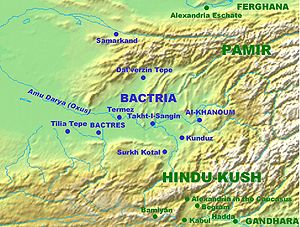
All the cities mentioned to a higher place later on became Silk Road trading centers and remained so into medieval times. All except Merv still exist. The Ferghana Valley, meridian right on the map, became the principal Silk Route route from Kashgar to Samarkand.
- xv Bactria. Before Alexander this region was also part of the Persian Empire; today most of it is in northern Afghanistan. A Graeco-Bactrian Kingdom ruled Bactria, Sogdia and Margiana for about ii centuries after Alexander'south death. Their capital letter is shown as Bactres on the map; today information technology is called Balkh.
From Central Asia he moved to invade the Indian Subcontinent. Along the style he founded several cities:
South Asia [edit]
The Western farsi Empire under Darius had included Gandhara, now in Islamic republic of pakistan, every bit its easternmost satrapy. Alexander invited the chieftains there to submit to him as the Empire's new ruler. Some did, but he invaded to subdue the others.

- Alexander founded two cities forth the Hydapses, Bucephela (named for his favourite horse) and Nicaea.
- Alexandria on the Indus. A boondocks with dockyards at the junction of two rivers, the Indus and the Acesines (now called Chenab).
- He as well founded another Alexandria at the oral fissure of the Indus.
The surface area Alexander took in the subcontinent included much of what is now known as the Punjab. The proper noun means "five waters" in Farsi and the region is named for five rivers visible on this map; four are tributaries of the Indus and the 5th is a tributary of 1 of those.
Taking Gandhara completed Alexander'due south conquest of what had been the Western farsi Empire. Afterward that many of his men were reluctant to march further east and some of the generals supported them, pointing out that they had already done a great deal and were a long way from homes and families. Alexander reluctantly acquiesced and led much of the army back to Persia, taking Sindh and Balochistan en route.
Later Alexander [edit]
Alexander made Babylon the upper-case letter of his new empire and retired at that place after India, building a navy on the Western farsi Gulf and plotting new conquests, starting with Arabia. He died in Babylon merely a few years subsequently in 323 BC; the cause is disputed with typhoid, malaria and poisoning equally the leading candidates. After his death, the empire was divided amongst his generals and at that place was fighting over the details.

The most important of the generals was Seleucus I Nicator who was given Babylon in the original sectionalization and conquered much more. The map shows the Selucid Empire (calorie-free blue) and other Greek-ruled states at the time of his death. This empire lasted until 63 BC when the Roman General Pompey ended it.
After seceding from the Selucid Empire, a Graeco-Bactrian kingdom ruled a large chunk of Central Asia until about 125 BC. In the second century BC, envoys from them and from the Chinese court both reached Kashgar and encountered each other in that location. This seems to accept been the starting time contact between Communist china and Europeans and information technology led to the establishment of Silk Route trade, with the Ferghana Valley every bit the main route betwixt Kashgar and Samarkand. Around 180 BC the Bactrian kingdom invaded the Indian subcontinent and a Graeco-Indian kingdom survived there until most 10 CE. Taxila has a lot of mainly Buddhist art with obvious Greek influences.
Another general, Ptolemy, became Pharaoh of Egypt with his capital at Alexandria, and built the famous library and lighthouse there. The concluding ruler of the dynasty he founded was Cleopatra, who died in 30 BC. Subsequently that, Egypt became a Roman province; Romans were appointed to the top jobs, while Ptolemaic Greeks were much of the professional person class both in government and outside it. Greek was the linguistic communication of government and Greek culture was quite influential until the Muslim conquest in 641 CE. The Egyptian linguistic communication now called Coptic, shortly written in a Greek-derived alphabet, is in liturgical utilise to this day.
Stay safety [edit]
While Alexander's conquest established new trading routes and a relative stability in the region, and while it is to some extent co-extensive with the Hippie Trail, much of the route is now unsafe.
In 1979 Islamic republic of iran was taken over past Shia extremists and Afghanistan was invaded by the Soviet Marriage; neither country has been entirely prophylactic since then. In this century U.s.a.-led coalitions take invaded Afghanistan and Iraq, while Syria has had a brutal civil war. Other countries in the region also have some problems.
See our article on War zone condom if you lot are even considering travel to Afghanistan, Iraq or Syria.

Alexander The Great Travel Map,
Source: https://en.wikivoyage.org/wiki/On_the_trail_of_Alexander_the_Great
Posted by: potterlond1937.blogspot.com
0 Response to "Alexander The Great Travel Map"
Post a Comment